
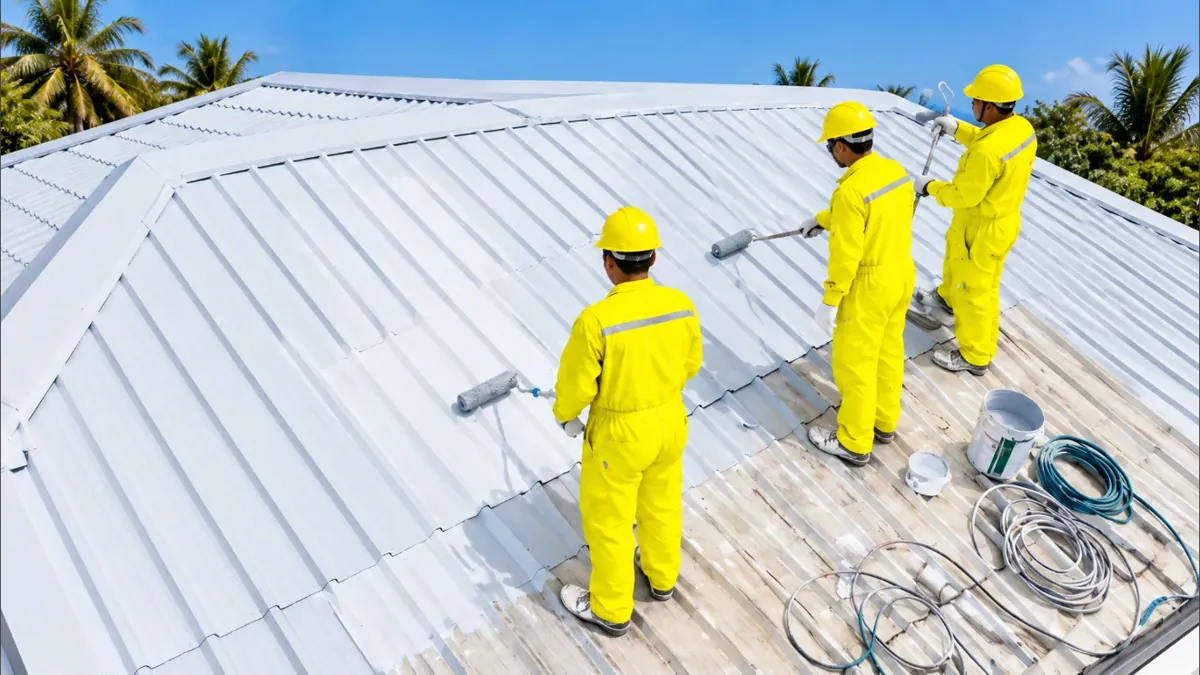
Roof Waterproofing South Africa is a different purchase to roof painting, and confusing the two is the most expensive mistake on this trade. A coating protects a surface that already sheds water. A waterproofing system is a thick membrane, torched on or built up as a liquid with a reinforcing fabric, meant to hold water out where it sits or where a joint moves. Say what the roof is and where it leaks, and compare priced quotations.
Super easy & fast
- Know what a square metre of waterproofing should cost, so you never pay too much.
- Send the same roof description to several waterproofers, and quotes come back fast.
- From LEADERR APPROVED providers, vetted and backed by many verified 5-star reviews. Peace of mind that the system quoted suits the roof rather than the price.
Describe your roof and get waterproofing quotes.
Get the Best QuoteRoof Waterproofing Prices
Ballpark figures so you can check a quotation.
| Item | Ballpark price |
|---|---|
| Stripping failed waterproofing, per square metre | R60 - R150 |
| Priming a concrete surface, per square metre | R25 - R60 |
| Liquid acrylic system with fabric, per square metre | R150 - R320 |
| Torch on membrane, per square metre | R250 - R450 |
| Fibreglass laminate, per square metre | R300 - R550 |
| Upstands and parapet detailing, per metre | R150 - R400 |
| Sealing around a pipe or vent, each | R350 - R1,200 |
| Reflective top coat over a membrane, per square metre | R45 - R110 |
| A flat roof over a single room, about 20 square metres | R5,000 - R11,000 |
Prices JUST UPDATED. Ballpark figures, rounded, excluding VAT. They reflect typical South African roof coating rates. They are not our prices or quotations, and no provider is bound by them. A roof is quoted on its AREA in square metres, on the PITCH and the HEIGHT, and on what the surface needs before any colour goes on, so confirm what each quotation includes, such as the wash, the rust or moss treatment, the primer or sealer, how many top coats, the access equipment, any ridge or flashing repair, and whether the gutters are cleared afterwards.
Where Waterproofing Is the Right Answer
- Flat and low pitch roofs. Water sits rather than running off, so a coating is not enough.
- Concrete slabs and balconies. Including the ones you walk on.
- Parapet walls and upstands. Where the roof turns up and the joint has to be sealed.
- Valleys and box gutters. The channels that carry the whole roof's water.
- Around penetrations. Pipes, vents and aerials, where most slab leaks begin.
The Systems in Common Use
- Torch on membrane. Bituminous sheet heat bonded down, lapped and sealed.
- Liquid applied systems. Built up in coats with a reinforcing fabric between.
- Fibreglass laminate. Resin and matting, used on smaller slabs and gutters.
- Cementitious slurries. Brushed systems for tanking and some concrete surfaces.
- Reflective top coats. Over a membrane, to take heat and sunlight off it.
How the Work Runs
- The leak traced first. Water travels, so the stain is rarely under the hole.
- The old system stripped. Failed membrane is removed rather than covered.
- The surface prepared. Dry, sound, clean and primed, or nothing bonds.
- The system built up. Laps, upstands and details done properly, not just the field.
- A water test. Flooded or hosed before anyone calls it finished.
Get a price for your own roof rather than a range.
Get the Best QuoteWhat Affects the Price
- The system chosen. A liquid system and a torched membrane are different prices.
- The square metres. And how much of it is detail rather than open field.
- What is there now. Stripping a failed system is a job before the job.
- The number of details. Pipes, upstands and corners are where the hours go.
- Access. Getting material and equipment onto the roof.
What to Include in Your Request
- The address. Suburb and town, so you reach contractors who work there.
- What the roof is. Concrete slab, low pitch sheeting, a balcony or a gutter.
- Roughly how big. Length and width of the area is enough to start.
- Where it leaks. And whether it is constant or only in driving rain.
- What is on it now. Bare concrete, an old membrane, or something painted on.
- Photos. The roof surface, and the damp patch inside.
Before You Appoint a Waterproofer
- Ask what system is quoted. By type, not by the word waterproofing.
- Ask about the old one. Stripped, or covered over and hoped for.
- Ask about the details. Upstands, pipes and corners, each priced.
- Ask about the guarantee. Length, what it covers, and who stands behind it.
- Ask for a water test. Before the final payment, not after the next storm.
- Ask about falls. Water that ponds on a flat roof shortens every system.
Roof Waterproofing FAQs
What is the difference between roof painting and waterproofing?
Roof paint is a thin protective and decorative coating on a roof that already sheds water by pitch and overlap. Waterproofing is a thick membrane or liquid system, usually with a reinforcing fabric, built to hold water out where it sits or where a joint moves. They use different products, different preparation and different prices, and one is not a cheaper version of the other.
How much does roof waterproofing cost in South Africa?
Commonly R150 to R320 a square metre for a liquid acrylic system with fabric and R250 to R450 for a torch on membrane, with stripping a failed system adding R60 to R150 and detailing around upstands and pipes quoted separately. A flat roof over a single room of about 20 square metres usually lands between R5,000 and R11,000.
How long does waterproofing last?
It varies by system, by how well it was detailed and by how much sun and standing water it takes. The field of a roof almost never fails first: leaks start at upstands, laps, corners and around pipes, which is where the hours and the skill go. A reflective top coat maintained over a membrane extends it noticeably.
Can waterproofing go over the old system?
Sometimes, if the existing membrane is well bonded, dry underneath and compatible with what is going on top. Often it cannot, because a failed system has water trapped under it and anything laid over that lifts and blisters. A contractor should cut a test patch and look rather than assume either way.
Why does my roof still leak after being waterproofed?
Usually because the leak was never at the point that was treated. Water runs along battens, slabs and beams before it shows on a ceiling, so the stain is often metres from the entry. The other common reason is a detail left out: a pipe, an upstand or a joint that the field coat ran up to and stopped.
Waterproofing is the job a coating cannot do, and the two get confused often, so Roof Painting Hub is the quickest way to see what the right system should cost.
Related Services
Get the Best Quote, Fast
Client Reviews
Powered by leaderr